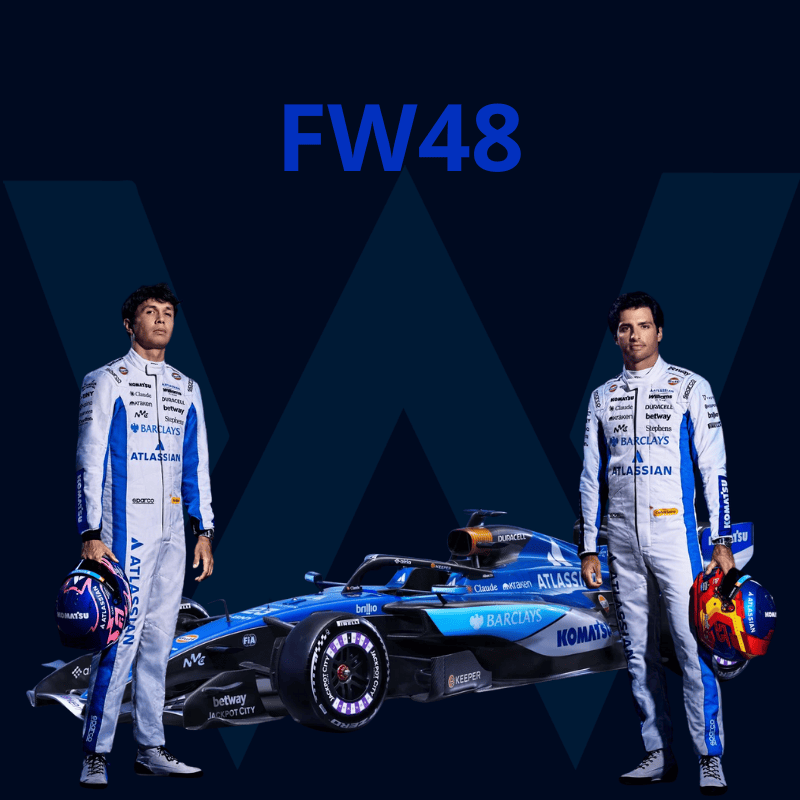

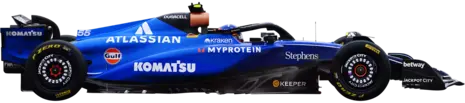
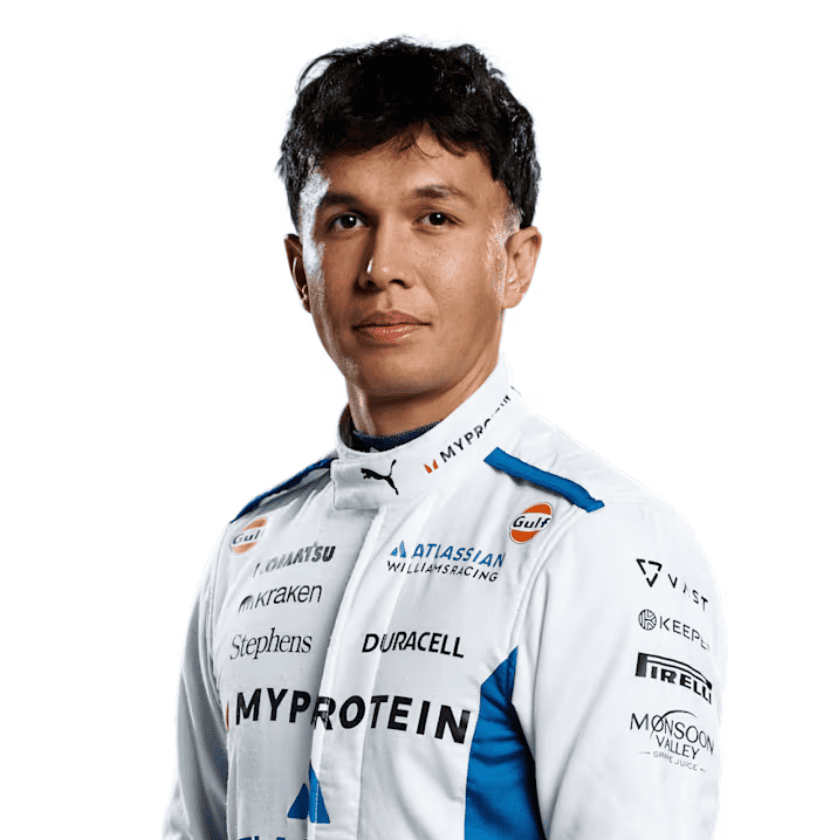
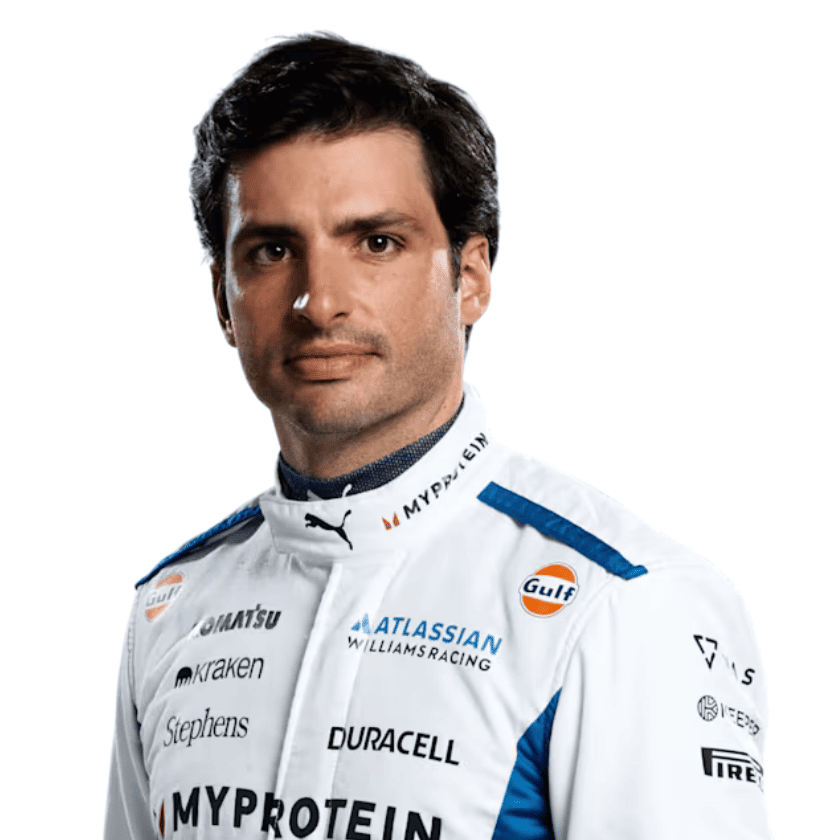
Forged by the vision, determination and relentless passion of Sir Frank Williams, the Williams team rose from modest beginnings to become one of Formula 1’s true giants. Across more than four decades, the British outfit amassed race wins, world titles and a legacy matched only by a select few rivals. Along the way, it played a pivotal role in shaping some of the sport’s greatest drivers and engineers. Following the Williams family’s decision to step aside after the sale of the team to Dorilton Capital in 2020, the organisation entered a new chapter, focused on long-term rebuilding and renewed competitiveness.
2025
Signs of sustained recovery emerge as Williams climb to fifth in the constructors’ standings, scoring 120 more points than the previous year. Carlos Sainz takes time to adapt to his new surroundings but delivers two podium finishes in the second half of the season.
2024
A difficult campaign results in a drop to ninth overall, with several heavy accidents disrupting progress late in the year. Franco Colapinto impresses after stepping in mid-season, while the headline moment is the announcement of Carlos Sainz joining Alex Albon for 2025.
2023
Under new Team Principal James Vowles, Williams rise to seventh in the championship. The FW45 shows strong qualifying pace and excellent straight-line speed, with Alex Albon’s seventh-place finishes in Montreal and Monza marking the team’s best results.
2022
Despite flashes of promise from the FW44, particularly through Alex Albon’s standout qualifying performance at Spa, Williams score just eight points and finish last in the standings.
2021
A welcome resurgence sees the team claim a podium at the rain-shortened Belgian Grand Prix thanks to George Russell. Williams improve to eighth overall in a season overshadowed by the passing of founder Sir Frank Williams in November.
2020
For the first time in their history, Williams endure a season without scoring a point. However, the future is secured as Dorilton Capital complete their takeover and closer technical collaboration with Mercedes is confirmed.
2019
A single point across the season marks the toughest campaign the team has faced. While results are scarce, rookie George Russell shines by outperforming team mate Robert Kubica in qualifying at every race.
2018
Performance continues to decline, leaving Williams at the foot of the standings. Lance Stroll and Sergey Sirotkin fight hard, but the points tally remains in single digits.
2017
The return of Paddy Lowe as Chief Technical Officer comes too late to reverse fortunes. The FW40 scores 83 points, highlighted by Lance Stroll’s unexpected podium in Azerbaijan.
2016
Williams slip to fifth in the constructors’ championship as development falls behind rivals. Valtteri Bottas scores the team’s only podium in Canada, while Felipe Massa retires from Formula 1 at season’s end.
2015
The team consolidate their status as the grid’s third force, but lose ground to a resurgent Ferrari. Bottas and Massa each score two podiums in a season where the FW37 excels on high-speed circuits.
2014
A strong chassis, Mercedes power and a solid driver pairing return Williams to the front. Although victories remain elusive, eight podium finishes secure third place overall.
2013
High expectations fade quickly as the Renault-powered FW35 struggles for competitiveness. Points are scarce, and Williams finish ninth in the standings.
2012
A switch to Renault engines brings mixed results. Pastor Maldonado delivers a memorable victory in Spain, but inconsistency and incidents hinder overall progress.
2011
One of the team’s most difficult seasons sees Williams score just five points. Reliability issues and lack of pace prompt major technical changes ahead of 2012.
2010
Results improve as the season progresses, with Rubens Barrichello finishing fourth in Valencia and Nico Hülkenberg taking a surprise pole in Brazil. Williams end the year sixth overall.
2009
Despite early promise with an innovative diffuser, the FW31 lacks podium pace. Consistency brings steady points, and a switch to Cosworth power is announced for 2010.
2008
A podium in Australia offers early hope, but development stalls. Williams finish eighth overall, with second place in Singapore as the season highlight.
2007
Improved reliability defines the year, significantly reducing retirements. Kazuki Nakajima replaces Alexander Wurz late in the season.
2006
A disappointing campaign ends with eighth in the standings. Early flashes of speed fail to translate into consistent results, with reliability a major concern.
2005
Williams finish fifth and bid farewell to BMW engines. A double podium in Monaco stands out as the year’s best result.
2004
After a difficult start and multiple driver changes, the team finish strongly with victory in Brazil, ending the season fourth overall.
2003
A dramatic late-season surge brings four wins and second place in the constructors’ championship, narrowly missing out on the title.
2000 – 2002
Despite regular race victories, Williams are unable to seriously challenge Ferrari’s dominance for championship honours.
1997
Jacques Villeneuve secures the drivers’ title as Williams claim their ninth constructors’ championship.
1996
Damon Hill wins the drivers’ championship and Williams add an eighth constructors’ crown to their record.
1994
A season marked by tragedy following Ayrton Senna’s death at Imola ends with Williams winning the constructors’ championship.
1993
Alain Prost claims his fourth world title before retiring from Formula 1.
1992
Nigel Mansell dominates the season, securing both drivers’ and constructors’ championships before departing for IndyCar.
1986
After suffering life-changing injuries in a road accident, Frank Williams continues to lead the team with unwavering determination.
1980
Alan Jones wins Williams’ first drivers’ championship, alongside the team’s first constructors’ title.
1979
Clay Regazzoni secures the team’s maiden Formula 1 victory at the British Grand Prix.
1978
Williams Grand Prix Engineering is founded, marking the beginning of one of Formula 1’s most storied teams.