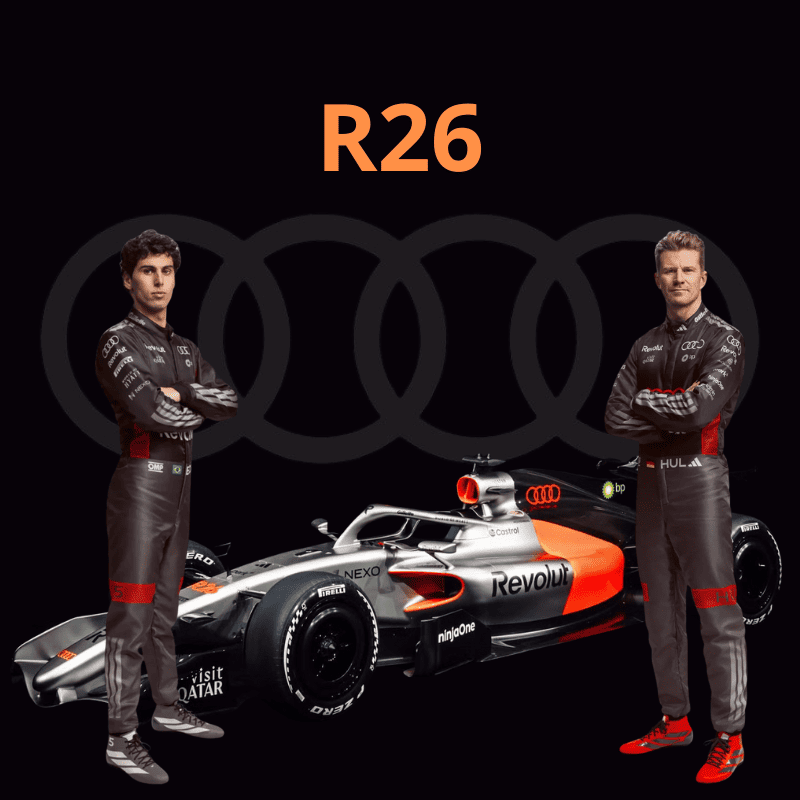

Since entering Formula 1 in 2026, Audi brings decades of global motorsport success to the grid for the first time. After announcing its intention to become a power unit supplier in 2022, the German manufacturer’s ambitions quickly expanded, leading to the acquisition of the Sauber team and the creation of Audi’s first full works outfit. The project is led by former Ferrari boss Mattia Binotto, with ex-Red Bull sporting director Jonathan Wheatley as Team Principal, while the driver line-up combines youth and experience in Gabriel Bortoleto and Nico Hulkenberg.
2025
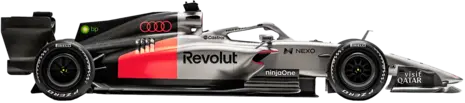
Audi presents the R26 Concept, previewing the livery and design direction of its first Formula 1 car. Revolut is announced as title sponsor for the 2026 entry.
2024
The team drops to last in the standings as the C44 proves uncompetitive, with early races also affected by pit stop problems. Performance improves slightly at the end of the season, with Zhou Guanyu scoring the only points finish, P8 in Qatar. Mattia Binotto joins the project.
2023
The final season under the Alfa Romeo name is disappointing, with the team finishing ninth overall. Best results are P8 finishes for Valtteri Bottas in Bahrain and Qatar.
2022
The team climbs three places in the standings. Valtteri Bottas thrives as team leader, while rookie Zhou Guanyu earns his seat. Late in the season, it is announced that the team will become the Audi works squad from 2026.
2021
Finish ninth in the championship behind Williams. Kimi Raikkonen scores 10 of the team’s 13 points before retiring at the end of the season. Preparations begin for Bottas and Zhou in 2022.
2020
Another difficult year ends with eighth overall. Both cars score points at Imola and reach Q3 in Turkey, but Raikkonen and Giovinazzi collect just eight points in total.
2019
Progress stalls as the C38 proves inconsistent, even with Raikkonen’s experience. The team retains eighth place in the standings, with a large points haul coming in Brazil.
2018
Under Fred Vasseur, the Ferrari-powered C37 shows strong improvement. Rookie Charles Leclerc scores 39 of the team’s 48 points, highlighting a sharp upward trend.
2017
A tough season yields only five points, but key changes arrive mid-year with Vasseur becoming Team Principal, an Alfa Romeo title sponsorship, and the signing of Charles Leclerc for the future.
2016
Early funding issues leave the team off the pace. After new owners arrive mid-season, Felipe Nasr scores two crucial points in Brazil, securing a top-ten championship finish ahead of Manor.
2015
Recovery season sees the team finish eighth. Rookie Felipe Nasr impresses alongside Marcus Ericsson, scoring points at nearly half the races.
2014
Worst season in team history, finishing pointless for the first time as the uncompetitive C33 struggles throughout the year.
2013
The C32’s unique design shows promise after mid-season tyre changes. Hulkenberg qualifies third and finishes fifth in Italy as most points come late in the season.
2012
A strong start includes podiums for Sergio Perez in Malaysia and Canada. Further podiums follow in Italy and Japan in an inconsistent but competitive year.
2011
Good first half of the season with regular Q3 appearances. Perez misses Monaco and Canada after a crash, but both drivers remain for 2012.
2010
Initial struggles with the Ferrari-powered C29 lead to technical changes. Performance improves later in the season with more consistent top-ten finishes.
2009
A difficult adaptation to new regulations, with podiums in Malaysia and Brazil as highlights. BMW announces its withdrawal and sells the team back to Peter Sauber.
2008
The F1.08 is highly competitive, giving Robert Kubica the team’s first win in Canada and multiple podiums. The team finishes third overall.
2007
Regular points finishes all season place the team firmly as best of the rest behind Ferrari and McLaren, with two podiums.
2006
First season under BMW control ends fifth overall. Robert Kubica scores a podium in Italy after replacing Jacques Villeneuve mid-season.
2005
Peter Sauber announces his intention to step down after agreeing to sell the team to BMW for 2006.
2004
A strong, consistent season sees points scored at most races and a sixth-place championship finish. Jacques Villeneuve is signed for 2005.
2003
A challenging year with points at only a handful of races. Best result is third at Indianapolis. The team finishes sixth overall.
2002
Eleven points secure fifth place in the constructors’ championship, with fourth and fifth in Spain as the best result.
2001
The team enjoys its best season to date, finishing fourth in the constructors’ standings.
2000
An eighth-place finish with six points, highlighted by two fifth-place results and a dramatic double retirement in Brazil.
1997
Johnny Herbert scores a podium in Hungary, the team’s standout result of the season.
1996
Herbert takes third in Monaco, with the team finishing seventh overall.
1995
The team’s first podium arrives at Monza, with Heinz-Harald Frentzen finishing third.
1993
In their debut season, the team scores points in its first race and finishes sixth in the constructors’ championship.