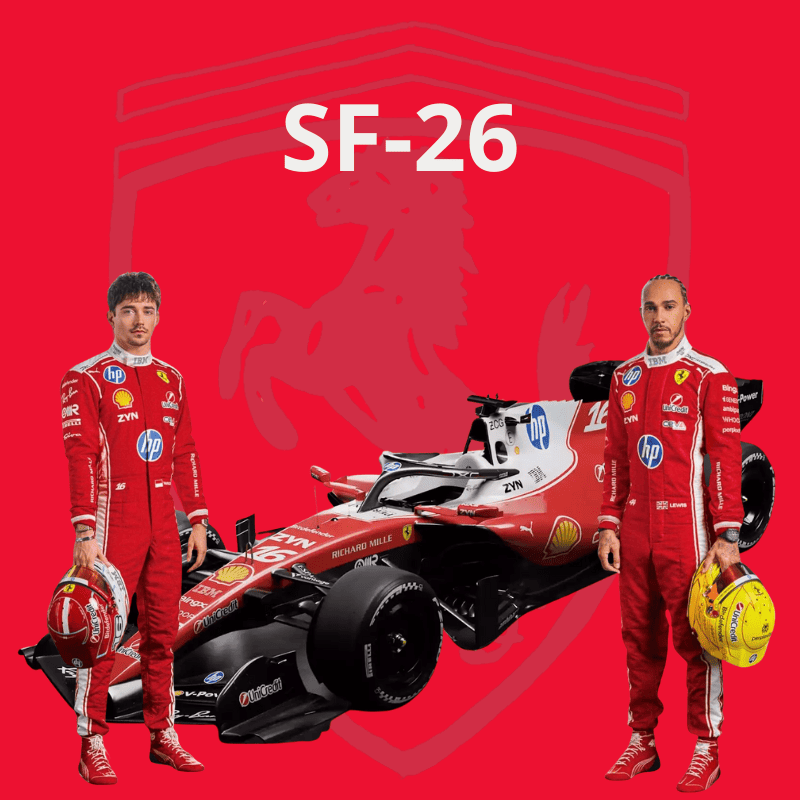


For countless fans, Ferrari and Formula 1 are virtually synonymous. As the only team to compete in every season since the world championship began, the Scuderia has evolved from Enzo Ferrari’s original vision into one of the most recognisable brands on the planet. Early triumphs with drivers such as Alberto Ascari and John Surtees laid the foundations, later reinforced by title-winning eras led by Niki Lauda in the 1970s and Michael Schumacher in the early 2000s. That Schumacher-led period delivered five consecutive championship doubles and cemented Ferrari’s status as the most successful team in Formula 1 history.
2025
The SF-25 proves difficult to extract performance from, particularly for newcomer Lewis Hamilton. A sprint victory in China is the main highlight, while Charles Leclerc reaches the podium seven times. Ferrari are never genuine title contenders and end the season fourth overall.
2024
Under Fred Vasseur’s increasingly settled leadership, Ferrari enjoy a strong campaign. Charles Leclerc and Carlos Sainz combine for five race wins, and the team finishes second in the constructors’ standings, narrowly losing out to McLaren at the final round. Lewis Hamilton is confirmed as Sainz’s replacement for 2025.
2023
Ferrari are the only team besides Red Bull to secure a race victory, thanks to Carlos Sainz in Singapore. Despite six pole positions and nine podiums, inconsistent results see them narrowly beaten by Mercedes for second in the constructors’ championship.
2022
A promising start sees Leclerc win two of the opening three races and briefly lead the title fight. However, reliability problems, strategic errors and driver mistakes derail the campaign. Ferrari finish second overall, while Sainz claims his first career victory at Silverstone.
2021
Although still short of challenging for titles, Ferrari make significant progress compared to 2020. They comfortably beat McLaren to third in the constructors’ standings, with Carlos Sainz narrowly outscoring Leclerc over the season.
2020
One of the darkest seasons in Ferrari’s modern history. The team fail to win a race, score only three podiums and slump to sixth overall. Vettel is informed early that his contract will not be renewed, while Leclerc scores the majority of the team’s points.
2019
Despite pre-season expectations, Ferrari struggle to convert speed into wins. Their first victory comes only in Belgium, with Charles Leclerc emerging as the leading scorer ahead of Sebastian Vettel amid a tense intra-team rivalry.
2018
Ferrari frequently possess the fastest car, yet are outperformed by Mercedes through strategy and development. Vettel delivers five wins but also commits costly errors, leaving the team second in the championship once again.
2017
A bold car concept brings Ferrari back into the title fight early in the season. However, technical setbacks and mistakes in the second half allow Mercedes to pull clear, despite Ferrari claiming five race victories.
2016
Momentum from the previous year fades as Ferrari struggle to match Mercedes and Red Bull. Regular podium finishes fail to translate into wins, largely due to strategic shortcomings.
2015
Sebastian Vettel replaces Fernando Alonso and leads a revitalised Ferrari effort. The team emerge as Mercedes’ closest challengers, achieving three victories, while Kimi Räikkönen trails his new team-mate.
2014
Ferrari endure a winless season for the first time since 1993, finishing fourth overall. Management upheaval follows, with multiple changes at Team Principal level before Maurizio Arrivabene takes charge.
2013
A competitive start sees Alonso fighting at the front, but qualifying weakness and mid-season tyre changes blunt Ferrari’s challenge. The team finish third behind Red Bull and Mercedes.
2012
The difficult F2012 evolves into a title contender through the season. Alonso leads the championship for much of the year, but Vettel narrowly prevails. Ferrari secure second in the constructors’ standings.
2011
A slow adaptation to new tyres leaves Ferrari playing catch-up. Alonso produces standout drives, including a win at Silverstone, but the team ultimately fall short, while Massa endures a difficult year.
2010
Ferrari open the season strongly, but struggle to maintain momentum against Red Bull and McLaren. Controversial team orders and late-season pressure see Alonso miss out on the drivers’ title.
2009
Ferrari are hampered by early development choices and misfortune, including Massa’s serious accident. Räikkönen secures a lone victory at Spa before departing at season’s end.
2008
A highly competitive season sees Ferrari claim their 16th constructors’ title. Felipe Massa narrowly misses out on the drivers’ championship, losing by a single point to Lewis Hamilton.
2007
Ferrari defeat McLaren in both championships after a dramatic season on and off the track. Kimi Räikkönen clinches the drivers’ title, while Ferrari secure the constructors’ crown.
2006
Ferrari mount a late charge against Renault, led by Schumacher’s seven victories. Despite the fightback, reliability issues cost them both titles by the narrowest of margins.
2005
Regulation changes hit Ferrari hard, particularly tyre rules. The team manage seven podiums and a controversial win at Indianapolis, finishing third overall.
2004
One of the most dominant seasons in F1 history. Ferrari lose just three races, with Schumacher claiming 13 victories and his seventh world title as the team secure another constructors’ crown.
2003
A tougher campaign still ends in success. Ferrari win a fifth consecutive constructors’ championship, while Schumacher becomes a six-time world champion.
2000 – 2002
Ferrari enter a golden era, sweeping both drivers’ and constructors’ championships for three consecutive seasons.
1999
Despite Schumacher missing much of the season through injury, Ferrari clinch the constructors’ title in the final race. Eddie Irvine narrowly misses out on the drivers’ championship.
1983
Ferrari secure their eighth constructors’ championship.
1979
Jody Scheckter wins the drivers’ championship, marking Ferrari’s last drivers’ title for over two decades.
1975 – 1977
Niki Lauda delivers two drivers’ championships, including a remarkable comeback following his near-fatal accident in 1976.
1964
John Surtees claims the drivers’ title, becoming the only world champion on both two wheels and four.
1961
Phil Hill leads Ferrari to both the drivers’ and constructors’ championships.
1958
Mike Hawthorn secures Ferrari’s third drivers’ title.
1956
Juan Manuel Fangio wins his fourth world championship driving for Ferrari.
1952
Alberto Ascari claims the first of two consecutive drivers’ championships with Ferrari.
1951
José Froilán González delivers Ferrari’s maiden Formula 1 victory at the British Grand Prix.